The Hidden Fat That Drives Disease
Understanding visceral fat, and the evidence-based ways to reduce it.
Why the Fat You Can’t Pinch Matters
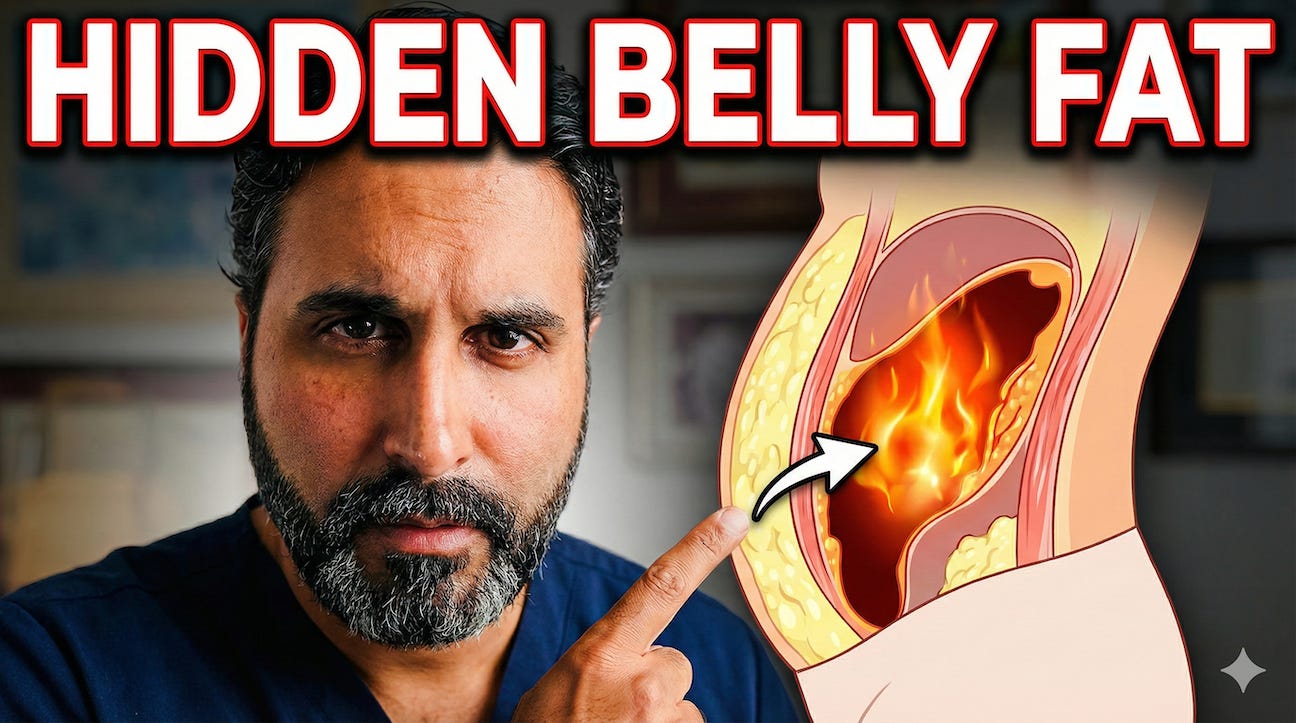
Many people worry about the number on the scale, but the most dangerous fat in the body is often the fat you cannot see or pinch. Visceral fat—the fat stored deep around the organs, the fat contributing to the “beer belly”—behaves very differently from the fat under the skin. It acts like an endocrine organ, releasing inflammatory signals that influence the heart, liver, pancreas, and even the immune system.
This is a question I’m often asked by patients: if visceral fat is so dangerous, what actually reduces it?
Many people assume the answer is simply “do crunches” or “lose weight,” but the biology is more nuanced than that. You may know someone who has struggled with metabolic health despite not appearing overweight, which is part of why visceral fat has become such an important topic in modern medicine.
When researchers study interventions that reduce visceral fat, a pattern emerges. No single intervention works in isolation. Instead, the evidence consistently points toward a coordinated approach involving metabolic signaling, nutrition, physical activity, sleep, and in some cases, medications. Understanding how these pieces fit together is what allows patients to make meaningful progress rather than chasing one new health trend after another.
Key Takeaways
• Visceral fat is metabolically active tissue linked to inflammation, fatty liver disease, diabetes, and cardiovascular disease.
• In most studies, visceral fat reduction closely tracks overall weight loss, so claims of “spot-reducing” visceral fat should be treated skeptically.
• Certain medications—particularly GLP-1 receptor agonists and related therapies—can significantly reduce visceral fat by promoting sustained weight loss and metabolic changes.
• Exercise has a disproportionate effect on visceral fat, especially when aerobic training is combined with resistance training.
• Lifestyle signals such as sleep quality, stress regulation, and circadian alignment influence where the body stores fat, not just how much fat is stored.
Additional Clinical Pearl: Visceral Fat as a Hormonal Organ
One of the most underappreciated aspects of visceral fat is that it behaves less like passive storage tissue and more like an active endocrine organ. Visceral adipose tissue secretes inflammatory cytokines and adipokines that influence insulin sensitivity, vascular health, and liver metabolism.
Clinically, this helps explain why two individuals with the same body weight can have very different metabolic risk profiles. A patient with relatively low visceral fat but higher subcutaneous fat may have normal metabolic markers, while someone with central visceral accumulation may develop fatty liver disease, insulin resistance, or cardiovascular disease even at moderate body weight.
This concept also helps clinicians interpret imaging findings such as epicardial fat around the heart or increased visceral adiposity on CT or MRI scans. These findings are not merely cosmetic—they represent a metabolically active environment that contributes to systemic inflammation.
For patients, the implication is important: interventions that improve metabolic signaling—sleep, exercise, stress regulation, and sustained weight loss—often have outsized effects on visceral fat compared with superficial fat stores.
My Personal Framework I Use When Applying This Information To My Own Health (or a Loved One’s Health)
When thinking about visceral fat for my own health or the health of someone close to me, I try to avoid the common trap of focusing on a single intervention. Instead, I think about the problem in terms of three biological signals that determine whether visceral fat accumulates or recedes.
First, I ask whether the body is receiving signals to store fat. Chronic sleep deprivation, elevated stress hormones, and repeated insulin spikes from highly refined foods all push metabolism toward fat storage. If those signals remain unchanged, even the best exercise program or medication will have limited impact.
Second, I think about the fuel supply. A sustained calorie surplus—particularly from high glycemic foods—creates repeated insulin elevations that favor visceral fat deposition. Improving dietary quality, increasing fiber intake, and aligning meals with circadian rhythms can gradually shift that metabolic environment.
Finally, I consider the mobilization signal. Physical activity—especially aerobic training combined with resistance work—creates the metabolic demand that allows stored fat to be used as fuel.
What is striking about the research is that these factors interact. Better sleep can reduce appetite the next day. Exercise improves insulin sensitivity. Stress management alters cortisol signaling that influences fat distribution. None of these variables operates in isolation, which is why the most effective approaches tend to address several of them simultaneously.
In practice, I try to think less about dramatic changes and more about sustainable signals that the body receives day after day.
Closing
From the complaints I hear from patients, and my own struggle, I believe visceral fat is one of the hardest problems to reverse. If you found these ideas useful, and you know someone who might find them helpful as well, feel free to pass this along.
And as always, thoughtful questions or reflections are welcome in the comments, especially from readers who are exploring these ideas in their own lives.
For those who are interested in seeing the biological mechanisms and clinical studies discussed in greater detail, I’ve also included a video exploration of this topic below.
Full Scholarly References on Visceral Fat and Metabolic Health
Agência FAPESP. (2025). Study points out that a synthetic molecule helps reduce visceral fat and improve sleep.
Baylor Scott & White Health. (2024). Cortisol belly: How stress can impact your weight (and what you can do about it).
Chawla, S., Tessarolo Silva, F., Amaral Medeiros, S., & Mekary, R. A. (2020). The effect of low-fat and low-carbohydrate diets on weight loss and lipid levels: A systematic review and meta-analysis. Nutrients, 12(12), 3774.
Coskun, T., Wu, Q., Schloot, N. C., Haupt, A., Milicevic, Z., Khouli, C., & Harris, C. (2025). Effects of retatrutide on body composition in people with type 2 diabetes: A substudy of a phase 2, double-blind, parallel-group, placebo-controlled, randomised trial. The Lancet Diabetes & Endocrinology.
Covassin, N., Singh, P., McCrady-Spitzer, S. K., St Louis, E. K., Calvin, A. D., Bukartyk, J.,... & Somers, V. K. (2022). Effects of experimental sleep restriction on energy intake, energy expenditure, and visceral obesity. Journal of the American College of Cardiology, 79(13), 1254–1265.
Daubenmier, J., Kristeller, J., Hecht, F. M., Maninger, N., Kuwata, M., Jhaveri, K.,... & Epel, E. (2011). Mindfulness intervention for stress eating to reduce cortisol and abdominal fat among overweight and obese women: An exploratory randomized controlled study. Journal of Obesity, 2011, 651936.
Eli Lilly and Company. (2025). Lilly’s triple agonist, retatrutide, delivered weight loss of up to an average of 71.2 lbs along with substantial relief from osteoarthritis pain in first successful Phase 3 trial.
Ghosal, S., Sinha, B., Ghosal, A., & Sarkar, S. (2025). Comparative efficacy of lifestyle and GLP-1RA-based interventions for visceral adipose tissue reduction: Meta-analysis of 36 randomised controlled trials. Obesity Abstracts, 5(P1).
Heimann, A. S., Singh, P., Ferro, E. S., Greenway, F., & Krongrad, A. (2025). Pep19: A novel approach for reducing visceral fat and improving sleep quality in obese adults—results from an early-stage clinical trial. Diabetes/Metabolism Research and Reviews, 41(5), e70056.
Hewell, K. D., Vaschillo, E. G., & Vaschillo, B. (2011). Stress and abdominal fat: Preliminary evidence of moderation by the cortisol awakening response in Hispanic peripubertal girls. Journal of Behavioral Medicine.
Iannetta, D., et al. (2024). Zone 2 intensity: A critical comparison of individual variability in different submaximal exercise intensity boundaries. Frontiers in Physiology.
Jayedi, A., Soltani, S., Zargar, M. S., Khan, T. A., & Shab-Bidar, S. (2020). Abdominal visceral adipose tissue and all-cause mortality: A systematic review. Frontiers in Endocrinology.
Kelley, G. A., Kelley, K. S., & Pate, R. R. (2016). The effect of diet or exercise on visceral adipose tissue in overweight youth. Childhood Obesity.
Li, C., et al. (2022). GLP-1 RAs and SGLT-2 inhibitors for insulin resistance in nonalcoholic fatty liver disease: A network meta-analysis. Journal of Clinical Medicine.
Lopez, P., et al. (2025). Comparing exercise modalities during caloric restriction: A systematic review and network meta-analysis on body composition. Frontiers in Nutrition.
Pramyothin, P., et al. (2024). Impact of diet intervention on visceral adipose tissue and hepatic fat in patients with obesity and type 2 diabetes: A randomized controlled trial. Scientific Reports.
Rao, G. H., Powell-Wiley, T. M., Ancheta, I., & Hairston, K. (2019). The impact of exercise and pharmacological interventions on visceral adiposity: A meta-analysis and systematic review. Mayo Clinic Proceedings.
Rynders, C. A., Thomas, E. A., Zaman, A., Pan, Z., Catenacci, V. A., & Melanson, E. L. (2019). Effectiveness of intermittent fasting and time-restricted feeding compared to continuous energy restriction for weight loss. Nutrients, 11(10), 2442.
Society of Chile for Obesity (SOCHOB). (2026). Efficacy of weight-lowering agents on fat distribution: A systematic review and network meta-analysis of randomized controlled trials.
Su, L., Fu, J., Sun, S., Zhao, G., & Cheng, W. (2019). Effects of high-intensity interval and moderate-intensity continuous training on body composition in overweight and obese adults: A systematic review and meta-analysis. PLOS ONE, 14(1), e0210292.
Sun, W., et al. (2025). Effects of sodium-glucose co-transporter-2 inhibitors on body composition in patients with type 2 diabetes: A systematic review and meta-analysis. Journal of Diabetes.
Tasali, E., Wroblewski, K., Kahn, E., Kilkus, J., & Schoeller, D. A. (2022). Effect of sleep extension on objectively assessed energy intake among adults with overweight in real-life settings: A randomized clinical trial. JAMA Internal Medicine, 182(4), 365–374.
Verheggen, R. J., Maessen, M. F., Green, D. J., Hermus, A. R., Hopman, M. T., & Thijssen, D. H. (2016). An exercise program to reduce abdominal visceral and subcutaneous fat in adults with overweight and obesity: A systematic review and meta-analysis of randomized controlled trials. Obesity Reviews.
Viana, R. B., Naves, J. P. A., Coswig, V. S., De Lira, C. A. B., Steele, J., Fisher, J. P., & Gentil, P. (2019). Effect of high-intensity interval training vs. moderate-intensity continuous training on fat loss and cardiorespiratory fitness in the young and middle-aged: A systematic review and meta-analysis. International Journal of Environmental Research and Public Health, 16(23), 4840.
Vissers, D., Hens, W., Taeymans, J., Baeyens, J. P., Poortmans, J., & Van Gaal, L. (2013). The effect of exercise intervention dosage on reducing visceral adipose tissue: a systematic review and meta-analysis of randomized controlled trials. Mayo Clinic Proceedings, 88(7), 712–721.
Weill Cornell Medicine. (2025, May 11). Head-to-head trial compares weight loss drugs.
Wewege, M., van den Berg, R., Ward, R. E., & Keech, A. (2017). The effects of high-intensity interval training vs. moderate-intensity continuous training on body composition in overweight and obese adults: A systematic review and meta-analysis. Obesity Reviews, 18(6), 635–646.
Xu, F., et al. (2023). The effects of GLP-1 receptor agonists on visceral fat and liver fat content in adults with and without diabetes: A systematic review and meta-analysis. Frontiers in Pharmacology.
Zelniker, T. A., & Braunwald, E. (2020). How do SGLT2 inhibitors and GLP-1 receptor agonists reduce cardiovascular outcomes? Arteriosclerosis, Thrombosis, and Vascular Biology, 40(2), 269–278.
Zhang, S., et al. (2024). Effect of intermittent fasting on obesity and metabolic indices in patients with metabolic syndrome: A systematic review and meta-analysis. BMC Endocrine Disorders.
Zhang, Y., et al. (2025). SGLT2 inhibitors reduce epicardial adipose tissue more than GLP-1 agonists or exercise interventions in patients with type 2 diabetes mellitus and/or obesity: A systematic review and network meta-analysis. Diabetes, Obesity and Metabolism.
**
This newsletter is for educational and informational purposes only and should not be considered personal medical advice. Always consult your physician or a qualified healthcare professional before making changes to your medications, diet, supplements, exercise, or health routine. Reading this content does not create a physician–patient relationship with Dr. Haque.